My name is Leah Udvadia. I’m 18 from Long Island, New York and a freshman in college majoring in Business Administration and hope to one day run my own photography business. I got my first real camera when I was 15 and before that I spent a lot of my time either painting or drawing, sometimes even writing on occasion. I grew up doing a lot of things like this on my own, which also means I was quite the introvert growing up. But I wanted a fresh start when I came to college and try new things, like being a lot more extroverted and outgoing. So far, this has helped me grow incredibly and I really want to keep expanding on that.
Blog #15
Not many people still sit and read books. Whether people find it too tedious or too boring. Personally, I used to read a lot more than I do now. And it’s something that I’ve wanted to start again. Things I have started reading again, they’ve had a lot of benefit to my life. I think doing some independent reading allows you to see into other worlds, views, and mindsets without the input of reality stepping in. Everyone has their own values and opinions, and a lot of the time the rules that are set into society and often conformed to, step in to peoples mind and can sometimes influence their opinions and thought process. But independent reading allows you to really get your own grasp on the world, other worlds, imagination.
Blog #14- E-Lit
Living in a world consumed by technology, it is bound to make its way into the world of literature, this is where E-literature comes in. Electronic Literature is exactly how it sounds, literature made to be read online. However, it is not a book that is printed as a hardcopy and then made to be viewed online. Something is considered electronic literature because of the elements of technology that are incorporated into it like pictures or music; things that enhance that reading experience. For example, a blog is a perfect example of electronic literature.
Alice In Wonderland- Collage Essay
Most children go through the imaginative phase with the limitless dreams. Wanting to be a cowboy, believing in magic, things the good majority of children stop believing in when they start to experience the loss of their innocence. Some children are even persuaded away from thinking in such an unrealistic way because reality will eventually hit them, and many people feel that this hurts them. In a way, it does. But it’s world of our own imaginations and the dreams we create as children and even as young adults that can help up come to terms with reality.
For children, it’s easier to see the world as more fun and colorful with their innocence. However, they have to make sense of this when it comes to understanding the adult world.
The Rabbit Hole
A world of dreams and childhood innocence is created down the rabbit hole in Lewis Carroll’s novel Alice’s Adventures in Wonderland, a coming of age story of a girl trying to get a grasp on reality through her own world of imagination.

Imagination involves the synthetic combining of aspects of memories or experiences into a mental construction that differs from past or present perceived reality, and may anticipate future reality(Longe 562).
Everyone processes things differently, we all do different things in order to understand new things. Children especially, growing up can be a difficult time and understand a world of harsh realities can be challenging. And children are no exception to using their own way to cope with reality.
Alice is a perfect example of her imagination running wild in order to get a mental grasp on the real world, in a world of her youth.
It’s in this world of childhood dreams and imagination where Alice learns about the loss of innocence and growing into an adult. The aspect of fantasy in this world helps her get a better grasp on the reality she is about to eventually go back to at the end of the novel. Through the novel we are brought with Alice on her adventure and see her struggle with the growth, at times literally.
It’s when she’s dropping down the famous rabbit hole that she is faced with realistic objects, bits and pieces of her life in the real world, in an unrealistic situation, in a rabbit hole falling into a fantasy world.
“However, she soon made out that she was in the pool of tears which she had wept when she was nine feet high.” (Lewis Carroll)
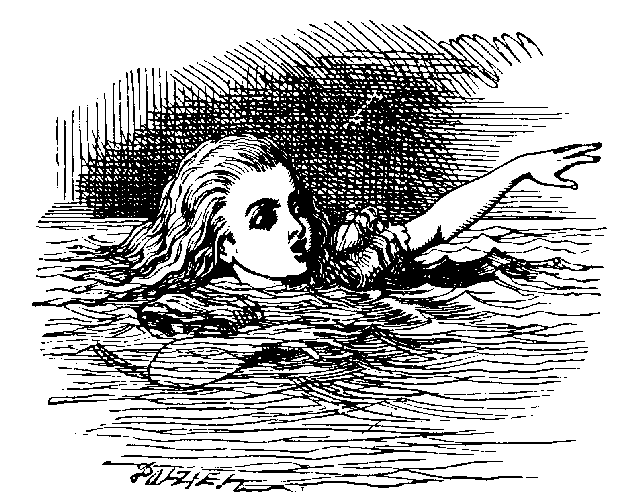
Alice in Pool of Tears
Lewis Carroll, Alice’s Adventures in Wonderland
Chapter Two: Pool of Tears

Shrinking back to a smaller size, she ended up having to swim her way out of her pool of tears. A problem she hadn’t had to face when she was nine feet tall. Of course, the meaning behind this has little to do with physical size. But to a child, the bigger you are the more you can do. This can be the case in some situations, yes. But not the important ones. Sometimes when growing up, we are faced with challenges that can bring us back down to a size that makes us feel like we can’t overcome a situation. But a part of growing up is realizing that you don’t have really be nine feet tall to overcome your challenges, you just have to stand taller than your challenges.
Reality is based on logic and rules covered by chaos and madness. Much like wonderland. As it’s often said, Wonderland is full of madness. Realistic objects and creatures put into an unrealistic world, that doesn’t make sense to young Alice trying to make her way through the world. And trying to make sense of these things can make you question yourself.
Once Alice enters Wonderland, she starts to question herself. As she explains to the Caterpillar.
“’Who areyou?’ said the Caterpillar
‘I-I hardly know, sir, just at present-at least I know who I waswhen I got up this morning, but I think I must have changed several times since then.’” (Lewis Carroll)

Growing and shrinking so much, walking right into a new world, Alice experienced so much change that she started to lose sight of who she thought she was.
Growing up for most young people is a lot of ups and downs, taking a step forward and then being pushed a step back. It can feel like you’re literally growing too tall or too small and can make you question who you are.
Work Cited
“Imagination.” The Gale Encyclopedia of Psychology, edited by Jacqueline L. Longe, 3rd ed., vol. 1, Gale, 2016, pp. 562-564. Gale Virtual Reference Library, https://link.galegroup.com/apps/doc/CX3631000381/GVRL?u=alfredtech&sid=GVRL&xid=c433ae80. Accessed 24 Apr. 2019.
Blog #11- Alice
Alice and Wonderland is known classic, a children’s story about adventure and imagination. But is it just a children’s story? Is it even a children’s story? It’s easy to consider this a children’s story because of its juvenile characters and storyline. However, the way the story is told and the lessons behind it can indicate that this could very well be a story for adults. For example, in the first chapter we see Alice’s astonishment when she see’s the rabbit in the coat. Something that would appeal to a child, but to an adult would come across as very odd. We see Alice’s logic and reason be tested as she falls down the rabbit hole and tries to wrap her mind around her new and fantasy-like surroundings.
Anxiety
You’re in a small room. You look around and there’s no windows, doors, nothing except four walls and the clothes on your back. You’ve seen other people escape, but somehow you can’t seem to crack how they did it. Suddenly, the room starts to fill with water. You keep looking around for an exit, water rising up to your knees as panic quickly washes over you. There’s a voice. “There’s a way out.”, it says. A familiar voice, you’ve heard it before. You trust it. More than anything. But still you think, It’s impossible. There’s no one, nothing to help you out. The sound of water rushing in fills the room and thinking straight is almost impossible, you look around for the source of the water. It’s coming in somehow, so there must be an opening. But there’s nothing, yet the water is now up to your waist. It’s impossible. There’s no way out. You’ve said this to yourself so many times that you’ve started to accept it. The water is up to your chest, walking is no longer possible.
How did you end up hear? How did you get in, but can’t make it out? You know how to swim, you could hold your breath easily, but this was different. There’s too much panic running through you to move your arms and legs to move. The water starts quickly rising up your neck and before you realize, it swallows you whole. You hold your breath and float, scanning the room again and through the water…there’s a door. But you still can’t move. You finally found your escape, but it’s too late. You close your eyes and accept what’s about to come. Just as you’re about to run out of breath, there’s a hand on your shoulder.
No, You think, I don’t want this to be it.
This can’t be it.
There has to be a way out.
They said so.
You open your eyes and scan the room again. There’s a door. The door you originally came through. You quickly swim towards it and just as you’re about to reach the knob, the water is gone. The room is completely dry, and yours. You were in your bedroom the whole time. But there was so much blocking your reality that you couldn’t see it. Not until you pushed down that wall. You were in your room the entire time, yet you felt so trapped. You couldn’t breathe, you couldn’t move, there was no escape. Except there was.
The mind is tricky. It’s a good hiding place for a lot of us, but for some of us it’s our worst enemy. Simple things like holding your breath or moving your arms seem impossible. I came to college with an open mind, high hopes, excited. But that first night I went to bed in my new room, closed my eyes, and suddenly I was in a room filling with water and no way out. Of course, going away to college is extremely new and scary for most. But anxiety can corrupt the little things too. Sitting with friends, going to a party, trying to finish the last math problem of your homework, even forgetting something at home.
Take going to a friend’s house for a party. You go but you’re a little late, so everyone is already talking and laughing. You sit and try to catch up, but you still feel somewhat out of the group. Maybe they don’t want me here? You think. Of course, no one said this, but your mind came up with the possibility so quick and it’s been sitting in there long enough that you’ve already started to believe it. One of the best story tellers I’ve met in my life, is my mind. It manufactures some of the most believable stories, sometimes even the scariest. But how do you not listen? It’s your mind. And how do you escape? You can’t.
Except you can. You always can. Something I tell other people all the time, but somehow always forget myself. But it’s possible. The worst thing about your mind is that you can think about anything, sometimes without wanting you. But the best part about your mind, is that it still is your mind. The best thoughts that can keep you from drowning can come just as quickly as the thoughts that can hold you underwater. You just have to find the tool to break down that wall and see it.
“The Lesson” and Society
As I’m sure we are all aware of, we live in a world where social hierarchy is almost inevitable, not matter how we try to avoid it. There is a distinct difference between the difference in social classes. Toni Bambara’s work “The Lesson” brings us into the economic differences we see in society. When a group of children are brought to a toy store, they see the extreme prices and are astonished. The price of some of the toys they see could potentially cover the expenses they need for for their families, and the possibilities that some people are given are revealed to the children. It’s no secret that some people look at price more than others, because some people have too. And this is something that the children learn when they see how expensive a toy is and compare it to what they need to survive the day.
Water by the Spoonful- Directors Statement
Water by the Spoonfulis a story of recovery and a haunting pass that comes back and effects the future. The play starts out with cousins Elliot and Yazmin going to get a phrase translated from Arabic that Elliot heard when he was a Marine in Iraq several years back. A phrase that haunted him for years, as we can see when they show Elliot at work and he is taking orders and hearing the phrase in the back of his mind. Elliot is the son of a recovering addict, Odessa, who runs an online support group for other recovering addicts. Odessa and the other two people in the support group, with the usernames “Orangutan” and “Fountainhead”, are very close and lean on each other heavily for support. Odessa’s past with her struggle with addiction is something that ends up coming back in the play and plays an important part in a key point of the story and leads to a lot of trauma for not only her, but Elliot. The struggle Odessa had with addiction is what led to the death of her daughter Mary-Lou and Elliot than being put in the care of Odessa’s sister Ginny. The title Water by the Spoonful comes from the story we hear from Elliot while confronting his birthmother about paying for flowers for Ginny after her passing. Because of a stomach flu, Elliot and his sister couldn’t keep anything down, any liquid or food came right back up. Something that went on for three days. Odessa ended up feeding them water from a spoon every five minutes to avoid hydration. However, Odessa didn’t stay. She admits to leaving her children alone and neighbors coming in the find the children in a pile of laundry. Elliot’s only solid memory of the aftermath of his mother leaving the house being the police saying that his sister was found dead from dehydration. A key theme in the play is recovery. Recovery from drugs more obviously, but also recovering from the past. We see a big issue in the play is the past coming back, which is why the confrontation between Odessa and Elliot is a key point in the play.
In the 7thscene of the play, Odessa, John (fountainhead), Yaz, and Elliot are sitting in a both. They’re discussing the arrangements for Ginny’s funeral and Elliot is set on Odessa paying for at least the flowers. Considering that she is the women that raised her son. However, Odessa says she can’t afford to. After getting fed up, this is when Elliot snaps. He tells his cousin to stay and tells the story of his sister’s death, his mother seeming to feel no remorse. But after Odessa abruptly leaves, we see that she went home and overdosed.
If I were to direct this scene, I would have Elliot sitting across from Odessa, showing the frustration he feels. Leaning over the table as he reminds his mother of the past. Reminding her of this is what leads to her eventually using again. Odessa seems to be unphased, or at least like she won’t show remorse for her actions. Having her avoid eye contact with Elliot is a way to show her trying to hide how she really feels. Yaz and John are in the scene as well, however the interaction with Odessa and Elliot is what is most important and what should have the most emphasis.
Hamlet and Tragedies
Shakespeare’s play Hamlet is a prime example of a tragedy, as well as one o this most well-known plays. We start off being introduced to our protagonist, Hamlet himself, after the death of his father who happens to be the king. After finding out his father was murdered by his uncle, he starts planning to kill his uncle in order to avenge is fathers death. According to The Seagull Book of Poems, a tragedy introduces the protagonist in a state of prosperity. Hamlet is wealthy and a prince. A tragedy also involves a protagonist having a conflict with a larger force, in this case the greater force is Hamlet’s uncle Claudius. The conflict reaches its breaking point at the climax, which is when Claudius and Hamlet fight at the end of the play and eventually end up both dying, along with the other characters of the play. A lot of the reasons for this play being a tragedy are quite obvious. To start off, every character in the play ends up dying. It’s debated whether or not Hamlet should be considered a “tragic hero” or not. If killing his uncle to avenge his father was the right option, because if he hadn’t, Hamlet may have lived.
Poetry and Human Rights
Human rights has been a fight for decades. What we do or don’t have a right to as human beings, what are we entitled to and what is just a luxury we have to earn, and more importantly, who deserves what? But fighting for it doesn’t mean people will listen. It often occurs that some people will only listen to certain people. Which is why poetry may be an effective tool that can help fight for human rights.
“Some view our stable race with a scornful eye”. Phyllis Wheatley writes this in her poem “On Being Brought from Africa to America”. Which gives a very poetic explanation of how minorities are viewed. People are people, but the differences in us are what start to create these mixed ideas about what actually differentiates one person from the next. Poetry gives the reality of it, the gruesome reality of humanity and yet somehow makes it less harsh. “I love this cultured hell that tests my youth” says Claude McKay in his poem “America”. He turns the harsh treatment he receives from society into something that benefits him. He doesn’t soak in the negativity that derives from such behavior from others. “Giving me strength erect against her hate”. The lack of rights creates more strength to fight for it in his eyes. He takes the “hate” and builds up his strength to better his life and he doesn’t let it keep him down.
Poetry is a device that helps express feelings, good or bad. In this case, poetry is supporting a fight. As humans we have things that obviously make us different, with one things constantly in common. Our humanity, and taking the face away from the fight is in a way a reminder that we are all human. And it shouldn’t matter what you’re seeing, but what you’re hearing.
 Leah's Blog