Most children go through the imaginative phase with the limitless dreams. Wanting to be a cowboy, believing in magic, things the good majority of children stop believing in when they start to experience the loss of their innocence. Some children are even persuaded away from thinking in such an unrealistic way because reality will eventually hit them, and many people feel that this hurts them. In a way, it does. But it’s world of our own imaginations and the dreams we create as children and even as young adults that can help up come to terms with reality.
For children, it’s easier to see the world as more fun and colorful with their innocence. However, they have to make sense of this when it comes to understanding the adult world.
The Rabbit Hole
A world of dreams and childhood innocence is created down the rabbit hole in Lewis Carroll’s novel Alice’s Adventures in Wonderland, a coming of age story of a girl trying to get a grasp on reality through her own world of imagination.

Imagination involves the synthetic combining of aspects of memories or experiences into a mental construction that differs from past or present perceived reality, and may anticipate future reality(Longe 562).
Everyone processes things differently, we all do different things in order to understand new things. Children especially, growing up can be a difficult time and understand a world of harsh realities can be challenging. And children are no exception to using their own way to cope with reality.
Alice is a perfect example of her imagination running wild in order to get a mental grasp on the real world, in a world of her youth.
It’s in this world of childhood dreams and imagination where Alice learns about the loss of innocence and growing into an adult. The aspect of fantasy in this world helps her get a better grasp on the reality she is about to eventually go back to at the end of the novel. Through the novel we are brought with Alice on her adventure and see her struggle with the growth, at times literally.
It’s when she’s dropping down the famous rabbit hole that she is faced with realistic objects, bits and pieces of her life in the real world, in an unrealistic situation, in a rabbit hole falling into a fantasy world.
“However, she soon made out that she was in the pool of tears which she had wept when she was nine feet high.” (Lewis Carroll)
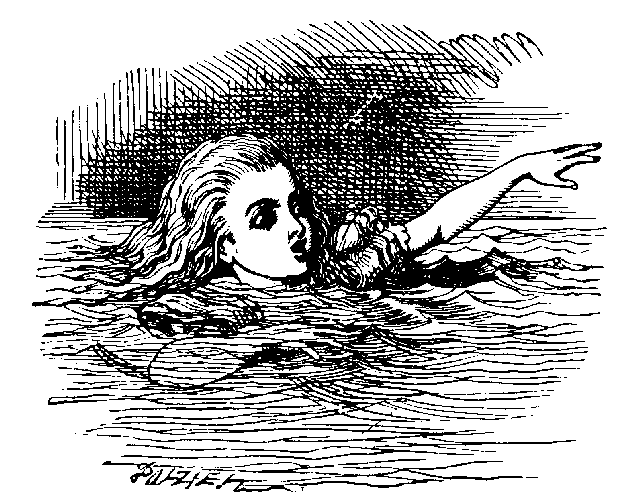
Alice in Pool of Tears
Lewis Carroll, Alice’s Adventures in Wonderland
Chapter Two: Pool of Tears

Shrinking back to a smaller size, she ended up having to swim her way out of her pool of tears. A problem she hadn’t had to face when she was nine feet tall. Of course, the meaning behind this has little to do with physical size. But to a child, the bigger you are the more you can do. This can be the case in some situations, yes. But not the important ones. Sometimes when growing up, we are faced with challenges that can bring us back down to a size that makes us feel like we can’t overcome a situation. But a part of growing up is realizing that you don’t have really be nine feet tall to overcome your challenges, you just have to stand taller than your challenges.
Reality is based on logic and rules covered by chaos and madness. Much like wonderland. As it’s often said, Wonderland is full of madness. Realistic objects and creatures put into an unrealistic world, that doesn’t make sense to young Alice trying to make her way through the world. And trying to make sense of these things can make you question yourself.
Once Alice enters Wonderland, she starts to question herself. As she explains to the Caterpillar.
“’Who areyou?’ said the Caterpillar
‘I-I hardly know, sir, just at present-at least I know who I waswhen I got up this morning, but I think I must have changed several times since then.’” (Lewis Carroll)

Growing and shrinking so much, walking right into a new world, Alice experienced so much change that she started to lose sight of who she thought she was.
Growing up for most young people is a lot of ups and downs, taking a step forward and then being pushed a step back. It can feel like you’re literally growing too tall or too small and can make you question who you are.
Work Cited
“Imagination.” The Gale Encyclopedia of Psychology, edited by Jacqueline L. Longe, 3rd ed., vol. 1, Gale, 2016, pp. 562-564. Gale Virtual Reference Library, https://link.galegroup.com/apps/doc/CX3631000381/GVRL?u=alfredtech&sid=GVRL&xid=c433ae80. Accessed 24 Apr. 2019.
 Leah's Blog